INTRODUCTION
The Malibu Lagoon project -
hereinafter "lagoon project" or simply "project" - like
many others of its kind, is the result of the environmental movement that has
its roots in the eastern United States' mid-19th Century
transcendental
naturalism best known in the works of Ralph Waldo Emerson and Henry David
Thoreau.In the west, it may be said to have begun with the travels of
geologist John Muir in the Sierra, particularly Yosemite, and his meeting there
with Emerson and other fellow naturalists in 1871.Decided in terms of
nuisance, the January 7, 1884 Sawyer decision
which banned hydraulic mining producing uncontrolled tailings, although a
matter of stare decisis rather than legislation, is widely regarded as
California's - if not the nation's - first environmental law.Closer to home,
it was near the end of the 19th Century that Malibu brought the inherent
transcendental naturalism of Frederick Hastings Rindge to its fullest expression.
It was the dust bowl era of the
early 1930s that led to establishing the nation's soil conservation districts.
In California - with unprecedented population increase after World War II - the
accompanying need for regulation of future development beyond that of normal
civic planning became an important concern.Locally, the Topanga Soil Conservation
District was formed in 1961 and became the Topanga-Las Virgenes Soil Conservation
District (TLVSCD) the following year.That brought much, if not all, of the
Malibu Creek watershed within its purview.By statute in 1971, "Soil
Conservation District," in California was replaced with "Resources
Conservation District," although as late as 1989, the TLVSCD designation
was still in effect.Now the Resources Conservation District of the Santa
Monica Mountains (RCDSMM) either is the former TLVSCD or an enlargement of it.
Resource conservation districts
like RCDSMM, with limited tax funding, are supported largely by fees, gifts,
grants, and the work of volunteers.In considering such work, phrases such as "boots-on-the-ground"
and "grass roots" come to mind.In fact, the data volunteers develop
are largely the basis for demonstrating environmental conditions of which state
legislatures and County governments may, at their pleasure, take cognizance.
The need for information regarding local environmental conditions was nowhere
more apparent than those initially considered by RCDSMM that eventually gave
rise to the lagoon project.
Aside from investigating putative
problems of conservation, the special value of districts such as RCDSMM -
reportedly at this time, ninety-eight of them - is that they provide a forum
for individuals and organizations, public and private, to bring to official attention
various real or imagined environmental problems.In this regard, the work of
RCDSMM has particularly focused on the Malibu Creek watershed.
Environmentalism, as now should
be apparent to all, has developed a scope so broad - involving in one way or
another most of the individual's
daily activities and surroundings - that serious questions have arisen as to
the wisdom of its application in certain situations.As with most efforts
related to legislation, the heart of an environmental project is its funding -
the scheme by which a portion of tax revenues support not just a specific
project, but also the complex governmental hierarchy through which it must be
evaluated.Careful consideration of circumstances in some instances can provide
object lessons demonstrating how the aims of forthright investigation and
legislative support can be perverted to ends inimical not just to the
environment, but to good government, generally. As a case in point, the lagoon
project has been completed, and with due respect to the Bard, like it or not,
thereby hangs a tale.
ENVIRONMENTAL LEGISLATION - 1970s
Modern environmentalism began
with the National Environmental Policy Act (NEPA), of 1970, the policy of
which was, generally, to "...assure for all Americans safe, healthful,
productive, and aesthetically and culturally pleasing surroundings..." (Ferrey,
2010, p.7).For present purposes, the most significant aspect of NEPA was
that the Environmental Impact Statement process it requires apparently served
as a model for the Environmental Impact Report (EIR) of the 1970 California
Environmental Quality Act (CEQA).Further, because of related concern, the
California Coastal Commission (CCCom) was formed by a voter initiative
referendum in 1972.In tandem with the 1976 California Coastal Act (CCA), CCCom
was made permanent.As such, it became the agency responsible for final approval
of the lagoon project.CCCom is a quasi-regulatory agency and hence authorized
to limit or modify property rights, subject only to court challenge.
The character
of the lagoon project dictated that it be developed under the aegis of the
state's Natural Resources Agency within which the Department of Parks and Recreation
(DPR), CCCom, and the California Coastal Conservancy (CCCon) all reside.In accordance
with CEQA, elucidated as Public Resources Code RC (PRC) Division 13, the DPR
was the "lead agency" (PRC §21067) shepherding the lagoon project
through CEQA, with the City of Malibu a "local agency" (PRC §21062),
and the state's Los Angeles Regional Water Quality Control Board (RWQCB) a
"public agency" (PRC §21063), also involved.
An important element in the local
environmental scheme of things in this burgeoning environmental era was the
Tapia Water Reclamation Plant.Constructed in 1965, original planning called
for creek disposal of treated plant effluent.The plant's initial capacity of
6.5 million gallons per day of secondary-treated effluent has since been increased
greatly.Concerns for the effect of Tapia-plant effluent disposal on the
quality of Malibu Creek began to be taken seriously by the 1970s.As a result,
measures to dispose of effluent by spray irrigation and other non-potable uses
during the dry season had been instituted, with creek disposal strictly limited
during to the wet season.
Comment
An early and
enduring consequence of the environmental movement in California has been a
deluge of environmentally oriented organizations - literally hundreds of them
- conservancies, conservation districts, commissions, authorities,
"non-profit" organizations, and miscellaneous stakeholders,
all concerned - ostensibly - with protection and improvement of California's
environment, and most requiring funding for their particular brands of good
works.With the legislative backdrop of CEQA and CCA, the City of Malibu, incorporated March 31, 1991, was poised to begin its fervent - if not always
well-informed - involvement with the environmental movement.As subsequent
events have shown, Malibu's environmental milieu is replete with "activists,"
not just the well-meaning and serious-minded, nor the starry-eyed, frequently
emotional, and commonly ignorant goofy-greeners, but also others - neither particularly
well-meaning nor goofy - who seem to view the movement primarily as a public-fund
grab-bag and Malibu an environmental sitting duck.
A clear
implication of the particular scheme of approval of any project having significant
environmental impact, public or private, is the need for careful planning.Planning
by those who have a reasonable grasp of the subject is essential for proper
development at every level of society.Because of economic self-interest,
intelligent planning in the private sector is practically a foregone
conclusion, and for public urban planning per se, generally it is simply
a matter of a well reviewed melding of individual property rights with
community infrastructure requirements.However, as has become apparent, at least
in California since environmental issues took hold, regional engraftments of perceived
or imagined environmental issues has not only greatly expanded in scope the
planning process but also imbued it with error, dissention, opportunism, and in
some instances, actionable malfeasance.
This is especially the case where environmental projects involve disciplines
beyond the training or expertise of those in governmental agencies before whom
such plans must be presented.
Lagoon
project planning involved the early idea of a pristine and - if not blue - at
least a clear-water lagoon at the mouth of Malibu Creek, a natural species
refuge, a place to commune with nature, and a fanny-dipper's delight.It also
presented an outstanding opportunity for the DPR to expand its authority and
RWQCB to assert its talismanic character, all clearly in accord with the new
and conceptually marvelous California environmentalism.
1978 - 1984: INITIAL ENVIRONMENTAL INTERPRETATION
Apparently as part of
negotiations related to a possible sale of the Rindge family interests along
Malibu Creek, DPR obtained permission to conduct two preliminary studies, one
of Malibu Canyon the head of which is its confluence with Cold Creek, and the
other of the creek's lowermost half-mile reach.The latter included the area
south of the highway from the pier on the east to the Malibu Colony on the
west.That by Heiner and Bender (1983) was essentially an assessment of
conditions related to recreational uses in Malibu Canyon.A broad range of the
canyon's physical and ecological characteristics as well as its recreational
potential was discussed, and acquisition was recommended. The other, by
Tjaden, Roberts, and Pierce (1978) - hereinafter the "1978 study" -
was the first formal environmental investigation that included the lagoon area
Tjaden, a landscape architect,
and his two associates, a park interpretive specialist and a parks and recreation
specialist, prepared the 1978 study under supervision of DPR personnel with
similar professional backgrounds.DPR personnel with expertise in the fields
of ecology and history also were employed in its preparation.It includes a resource
management plan describing natural and cultural resources of the area, a general
plan of development, and an environmental impact report.The latter of these
concludes that the short-term effects of implementing the general plan would
not be significantly harmful and that the long-term effects would be beneficial.
It is primarily in a Resources
Management Plan, particularly pages 13-24 of the 1978 study, that the roots of
the lagoon project are to be found.At page 22, drainage modifications are
envisioned that:
"...would include restoring and enlarging the
saltwater marsh.Tidal waters will be allowed to penetrate deeper into the
backlands by means of graded-out channels..."
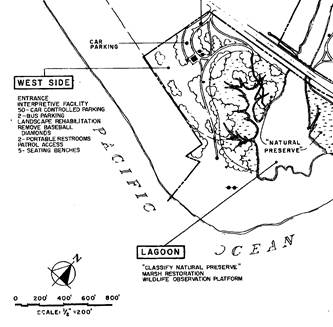
referring directly to the area
that was to become the lagoon project site as shown in Figure 1.
|
|
Figure 1.Part of Sheet 1, 1978 Malibu Lagoon State Beach General Plan.
This plan, drawn in December, 1977, was approved in
concept as part of the 1978 study.The area of the lagoon project is indicated
as the "West Side."
Apparently as an initial extension
of the 1978 study, DPR in 1983 decided to install several of the suggested "graded-out
channels" in the project area.There, by late 1929, it had been filled with
excavated materials from various local grading operations begun at least as
early as 1915.
That grading was a substantial undertaking, involving the excavation of three
channels with a total length of over 3,000 feet open to the creek mouth and the
construction of foot bridges across them for a pathway to the beach. Since
they were excavated for the specific purpose of providing habitats, it is
appropriate to refer to them as "eco-channels." Part III of this
review concerns their hydrologic character.
An agreement for sale of the
Rindge family's beach, creek floodplain, and canyon properties was confirmed on
December 9, 1983, although it is clear from the installation of the
eco-channels about the previous June that at least an informal agreement had
been reached.Title was transferred to the State of California early in January,
1984.
Comment
There seems little doubt that the
1978 study and that by Heiner and Bender were primarily for supporting the
proposed state purchase of the Rindge properties.The 1978 study does provide
some detailed ecological data, but as a hydrologic investigation it is superficial.
Rather than presenting a specific plan for development, it considers how the
lower reach of the creek might be developed to take advantage of it as a
natural preserve and recreational site.The focus subsequent concern was then,
and has been since, primarily on the biological character of the creek mouth.
It suffices for present purposes
to say that in terms of its physical characterization of the area, the 1978
study is essentially conclusional.It lacks supporting evidence for some of
the described physical conditions, and in certain respects it is clearly
incorrect.Most important in this regard is its failure to recognize that the
mouth of the creek is the seawardmost extension of a late-stage Holocene
deltaic floodplain with only minor development as a coastal marine salt marsh.
In 1978 and for years previously,
the project area had been simply a low hummocky expanse with no well defined
drainage system.The dendritic channel pattern shown in Figure 1 is simply an
artistic rendering intended to convey the idea of an enlarged salt-water marsh to
support an "interpretive facility." Describing the eastern and
western shores of the stream mouth as natural preserves demonstrates the early
fundamental failure to recognize the hydraulically dynamic character of the
Malibu Creek mouth.
Probably as a direct result of
the 1978 report however, subsequent plans for development were postulated on
the false premise that the project site could be "restored" to a
previous natural salt marsh and lagoon.Certainly in the past, salt-marsh
conditions had developed landward of barrier bars along the shore of the Malibu
Creek floodplain as well as elsewhere along the Malibu coast just as they do
today.Localized quiet-water conditions in the lees of coastal bars are to be
expected.Mugu lagoon, fed primarily by low-energy Calleguas Creek, an excellent
example.But the high-energy character of Malibu Creek precludes the development
of widespread marsh or lagoonal conditions in its floodplain.
Thus, suggested in the 1978
report, adopted as part of the conceptual planning, and adopted in the work by
Ambrose and Orme (2000) and their co-workers, hereinafter the "UCLA
study," the idea of a single salt-marsh and adjacent lagoon condition over
most of the Malibu Creek floodplain persisted.What the issue amounts to are mutually
exclusive theories regarding the manner in which the creek floodplain has
developed.One implies an essentially static low-energy floodplain-wide
marsh and adjacent lagoon, and the other a high-energy seaward progression
of shoreline bars. The former requires a single marsh and related lagoon
existed over most of the floodplain for a long period that within the past
2,000 years or so somehow became buried by relatively coarse-grained stream deposits;
the latter implies a succession of seaward-advancing barrier-bars with limited
marshes in their lees as the floodplain has aggraded seaward probably during the
past 40,000 years or more - a process still in progress.
As demonstrated in Part I of this
review, the progressive-bar theory is correct.Nevertheless, this has gone
unrecognized by some lagoon project proponents and presumably ignored by
others.Whether the floodplain-wide marsh-lagoonal theory: [i] captured the
imagination of project proponents due to ignorance coupled with nostalgia and
its ally, restoration, or [ii] was arbitrarily adopted by those, however
knowledgeable, as an effective selling point in language legislatively
necessary to fund the project, is left for others to ponder.
In any event, although neither true physical nor biotic lagoonal restoration
was possible, a proposed new set of entirely artificial conditions nevertheless
was billed as such.
Added by statute in 1976, PRC §31007
defines "coastal restoration project" as an action by a local public
agency or the CCCom "...to correct an undesirable development pattern in
the coastal zone..." Therefore, it has nothing to do with restoration, per
se.Further, PRC §31008 defines, somewhat tautologically, a "coastal
resource enhancement project," as an action "...to restore, as
nearly as possible, degraded natural areas to their original condition or to enhance
the resource values of a coastal zone."
The use of the internally
inconsistent phrase "...restoring and enlarging ..." in the quotation
at page 22 of the 1978 study is instructive. In any developed area, a
proposal to restore natural conditions without eliminating the artificial ones
- "back to the wild" so to speak - is impossible.At best, it
appeals to an emotional desire for the past that might result in improved conditions.
At worst, it simply panders to the PRC language, and introduces unforeseen
adverse conditions.Of course, for better or for worse, a "restoration"
project proposal can be a handy plank of typical sophistry in someone's political
platform.
For this pedantic and admittedly
somewhat caustic excursion into the roots of the lagoon project, no apology is offered.
It is only within such context that it can be objectively evaluated.
1989 - 2000: INITIAL TECHNICAL STUDIES
As part of its mission to conserve,
protect, and improve the Malibu Creek watershed generally, RCDSMM was called
upon to produce basic data in furtherance of the creek's lagoonal development.
In response, an ecological survey of the lagoon by Dillingham (1989) - hereinafter
the "1989 survey" - was prepared.That was essentially an introductory
investigation of physical and biological conditions "...to be used to
compare present lagoonal conditions with future environmental change..." (op.
cit., p.iv).Of special interest are chapters by Dagit (1989)
concerning physical and chemical characteristics of the creek mouth, and by
Dillingham and Sloan (1989) that considers eco-channel sedimentation.Presumably
at the behest of RCDSMM in recognizing the need to expand on the 1989 survey,
an ad hoc group of stakeholder public agencies - the Malibu Creek
Watershed Advisory Council (MCWAC) - was formed in 1991.
Comment
Although the 1978 study had
developed a certain amount of technical data useful in subsequent planning, the
1989 survey provided the first set of data by which actual planning for
improving environmental conditions of both the eco-channels and the creek mouth
could be addressed.For present purposes, the work of Dillingham and Sloan is
especially important because, as discussed in Part III of this review, their
observations concerning aspects of the eco-channels' hydrologic behavior help
to confirm the hydrodynamic character of the barrier bar.Generally, the 1989
survey was an important point of departure for the UCLA study.Those works and
certain observations by Sutula, et al.(2004), provided the only historic
hydrologic data for planning the lagoon project.
It is important to note that the
data developed for these works are all from periods of about a year.Although
in themselves legitimate studies, such limited investigations - "snapshots
in time" so to speak - can hardly have been an adequate basis for lagoon
project planning, because, as shown by Troxell and Hoffman (1954, Ch.VI, p.7,
Fig.3), climatic conditions in southern California - particularly rainfall and
hence runoff - have periodicities in the range of 10 to 50 years.
1991 - 2005: CONCEPTUAL LAGOON
PROJECT PLANNING
Conceptual planning of a project
may be defined as a more or less informal exercise advancing ideas of what
would be its most desirable and feasible function as a means of establishing
the character of an actual physical design.Although the record is somewhat
murky, conceptual planning for the lagoon project was approached, as most are,
though a hierarchy of organizations based on geographical boundaries.In the
case of the lagoon project, two parental groups, RCDSMM and MCWAC, initiated
conceptual planning.Probably because of its official status, this was carried
out under the nominal authority of RCDSMM, but MCWAC certainly was intimately involved.
Resource conservation districts
in California are formed under provisions of the Public Resources Code (PRC).Such
a district has geographic rather than political boundaries.Initially, the directors
of a district are individuals appointed by the local county board of supervisors.
Where districts include both city and county areas, directors are selected
proportionately from the included population sizes.Thereafter, county
supervisors and city councils, apparently referred to only as "local
agency formation commissions" (e.g., PRC §9301.1), determine
additional or replacement directors as the need arises.
There appears to be no provision
for formal review of the work of resource conservation districts - i.e.,
no official authority to which the directors are required to report except, one
assumes, to explain to funding sources the projects they recommend.The powers
of directors, enumerated in PRC §9401 - 9481, are very extensive.On the
other hand, stakeholder groups such as the MCWAC apparently have no official
status.Probably because districts are non-regulatory, challenges to their
activities seldom arise. Presumably, any such challenge would have to be either
through the courts or by appeal to the local agency formation commissioners
meeting in plenary session.It appears that within wide limits both RCDSMM and
MCWAC are essentially self-governing.Both have the option of appointing
committees and sub-committees to address specific problems and engage in
informal or formal "partnering"
with other agencies, and similar pursuits.
Although the record is somewhat
unclear, according to the Malibu Lagoon Restoration Project web site, RCDSMM
and MCWAC, apparently as a joint effort in 1991, formed the Malibu Creek
Watershed Council (MCWC), which may also have been called the Malibu Creek
Watershed Committee.Presumably with an eye to PRC terminology, and with the
excellent initial investigatory work of the 1989 survey, the Malibu Creek Advisory
Council (MCAC) was established in 1992.As a result, in May, 1995, the MCWC issued
a "1995 Natural Resources Plan" - a sort of environmental wish list -
outlining forty-four "action goals" deemed by some 40 stakeholder groups
desirable or necessary to improve or protect the Malibu Creek watershed.
Whether listed in order of importance is uncertain, but the twentieth of these
was to:
"Restore/enhance Malibu Lagoon and surfzone."
Whether the terminology of the
twentieth action item/goal intentionally parroted that of the PRC is uncertain,
but in any event, "restoration" and "enhancement," became
the watchwords faithfully repeated by lagoon project proponents thereafter in all
references to environmental work concerning it.
Thus, actual conceptual planning to
improve conditions in the lagoon was begun - as many such projects are - by the
formation of ad hoc committees.It appears that spurred on by
deteriorating conditions in the eco-channels, MCAC in 1995 established a Malibu
Lagoon Task Force (MLTF).It may have been at that time that non-public agency
stakeholders became part of the planning process.During 1995 - 2001, some fifty
meetings of MLTF were held attended by representatives of more or less directly
affected public agencies and various stakeholders.During the latter part of
this period, the findings and conclusions of the UCLA study must have strongly
affected meeting agendas.
Those participating in the MLTF
meetings fell into four groups: (1) political representatives; (2) representatives
of biologically oriented agencies and groups; (3) private-interest
stakeholders, and (4) representatives of agencies with mandates broad enough to
have on staff some with a working knowledge of geology, or hydrology, or civil
engineering.Attending at least some of the meetings reportedly included, at
various times, representatives of:
United States
Environmental Protection Agency
National Park Service
Natural Resources Conservation Service
U.S.Army Corps of Engineers
UCLA Department of Environmental Science and Engineering
University of Southern California
Los Angeles Regional Water Quality Control Board
CalTrans
Las Virgenes Municipal Water District
Los Angeles County Department of Beaches and Harbors
Los Angeles County Department of Public Works
City of Malibu
Heal the Bay
Humboldt State University, Department of Environmental Resources Engineering
Southern California Coastal Water Research Project
California State University, San Francisco, Department of Environmental Science
California Coastal Commission
Environmental Science
Of these groups, five or more
should have had members with at least a rudimentary knowledge of hydrology.
One may further presume that an overview of the proceedings was maintained by
partners with the RCDSMM in its lagoon project effort that included:
State Coastal Conservancy
Santa Monica Baykeeper
Santa Monica Bay Restoration Foundation
In September, 2001, the Malibu City Council upon being informed of the MLTF findings
voted unanimously to support its efforts.This was followed by twelve more
focused conceptual planning "mediated' meetings in a one-year period.Apparently as a direct result, the Malibu Lagoon Restoration
Working Group (MLRWG) was formed in 2003, aided by a newly formed Malibu Lagoon
Technical Advisory Committee (MLTAC), to create a final conceptual restoration
and enhancement plan As later noted (M&N staff (2005b, p 3), the result was
a unanimous recommendation for increased tidal flushing, improved water
circulation, increased holding capacity, and reduced predator encroachment.Of
these, the first three are of interest for present purposes.
Comment
Why labor the meaning of
"restoration" and "enhancement?" Good question.It is because
the use of these words - labels really - illustrates the foggy thinking that in
some quarters pervades the environmental movement in California.Aside from
their internal inconsistency, "restoring" and "enhancing"
from the beginning implied, and continue to imply, not only that the lagoon project
has been blessed by statutory fiat and technically authenticated, but also that
it is somehow intrinsically desirable and - oddly enough -
"sustainable"
even though such is generally not a characteristic of natural conditions,
whether or not actually restored.Nevertheless, with completion of the efforts
of MLRWG and MLTAC during 2003-2005, conceptual planning from the lagoon
project was completed.
Whether ex parte as to
general planning activities or a formal step during the conceptual planning process,
DPR approached Heal the Bay - or maybe it was the other way around - to discuss
how to ameliorate the condition of the eco-channels widely advertised by local
video as terrible and no longer to be endured.From this, there arose a
bifurcated approach to the lagoon project, one that concerned both its
hydrological and ecological aspects - conditions ripe for environmental funding
and agency intervention.Subsequently, presumably with the blessing of the
California Coastal Conservancy (CCCon), DPR and Heal the Bay became instrumental
in managing the lagoon project.Although in this regard the responsibility of
DPR as the project lead agency is clear, that of Heal the Bay is less so.In
any event, from all this there emerged a bifurcated approach to the lagoon
project, one that concerned both its hydrological and ecological aspects even
though it appears from the available record that at the managerial level there
was lacking a certain degree of expertise in the former of these disciplines.
Records regarding the actual
activities at the various meetings of MLTF, MLWG, and MLTAC are not immediately
available.Whether minutes were kept is uncertain.The stated goals of the
MLTF-envisioned conceptual plan of the lagoon project were primarily to
"restore" and "enhance" the area designated A-1 in the UCLA
study, i.e., where the eco-channels were located.Since efforts to increase
tidal flushing, improve water circulation, and increase holding capacity are hydrologic
in character, it seems clear that they met with the specific approval of MLWG
and MLTAC.Whatever reservations some committee individuals may have had, the
consensus seems to have been that the specified hydrologic goals were
considered physically possible and that simply a proper design was necessary to
achieve them.
2005
- 2013: PROJECT FEASIBILITY, DESIGN, AND CONSTRUCTION
The extensively experienced
geotechnical engineering firm of Moffatt & Nichol (M&N) was hired to determine
the feasibility of achieving the MLTF goals.Two studies were produced
(M&N staff, 2005 a,b).The first of these addressed various physical characteristics
of the local lagoon and project areas upon which were postulated four designs
designated Alternatives #1, #2, #1.5, and #1.75.Of them, Alternative #1.5 finally
was selected by DPR.Specifically, as noted by M&N staff (2005a, p.44), it
was intended to achieve:
- Tidal influence and wind driven circulation created
by a single main channel with a naturalized dendritic planform more indicative
of natural systems;
- Increased tidal flushing during open conditions by
deepening of the west lagoon (no work is proposed in the main lagoon).This
will also increase lagoon holding capacity (storage volume);
- Enhanced and increased salt marsh environment during
open conditions and maximized wind fetch to enhance circulation during closed
conditions.
This was followed by a June, 2005
report (M&N staff, 2005b) titled, "Final Malibu Lagoon Restoration and
Enhancement Plan" that specified the manner in which Alternative #1.5 was
to be implemented and monitored.Thus, the stage was set to satisfy CEQA requirements
regarding environmental impact.Within about a year, the project's draft EIR
by Jones & Stokes staff (2006a) was completed.Following the necessary period
of public review, the project's final EIR by Jones & Stokes staff (2006b)
was issued indicating (op.cit., p.11-17) that:
"Alternative #1.75 would be the environmentally superior
alternative. However, there is uncertainty as to whether Alternative #1.75
possesses the magnitude of the beneficial effects."
Whether this refers to the
beneficial effects of Alterative #1.5 or to some other one - perhaps even the
"no-project" alternative - is uncertain.However, this was immediately
followed by a statement of Overriding Considerations by DPR (Department of
Parks and Recreation staff, 2006), apparently a pro forma exercise
required by CEQA Guidelines §15093 for projects that have been found by the
lead agency to be environmentally acceptable - or desirable on other grounds -
despite certain adverse impacts.
A detailed review of the somewhat
convoluted events preceding CCCom's issuance of a coastal development permit
(CDP) for the lagoon project is unnecessary for present purposes.Issuance was
delayed because of protracted objections led by the Wetlands Defense Fund (WDF)
and the Coastal Law Enforcement Action Network (CLEAN) based on concerns about
the effects of construction on certain biota.In a court test, those
objections were found non-meritorious, and subsequently CDP 04-07-098 was
issued Apparently the WDF-CLEAN action did not address the fact that DPR was
seeking a CDP for a project entirely different from either the
M&N-recommended Alternative #1.5, or Alternative #1.75.
Subsequently, Jones & Stokes
contracted with DPR - and perhaps others - to produce an entirely different lagoon
project plan.That plan involved regrading the project site to a dendritic
stream pattern much more extensive and open than that of either Alternatives
#1.5 or #1.75.In February, 2008, during this redesign process, Jones &
Stokes was acquired by ICF, International (ICF).Consequently, new and
radically different lagoon plans were completed and issued as a product of ICF,
although it appears that the design was essentially that of Jones &
Stokes.Subsequent to CCCom review and the failed WDF-CLEAN court challenge,
construction reportedly was begun on June 4, 2012 by Ford, E.C., the general
contractor for the project, with subcontractors PBA Ltd.and Roberts General
Engineering.The work involved essentially revegetation, regrading, and the
installation of certain pathway and viewing structures.Thus, so far as the immediately
available record discloses, the design was entirely that of ICF nee
Jones & Stokes.The work was completed on March 11, 2013, and the official
opening ceremony for the project was held on May 8, 2013.
Comment
As early as March 4, 2006, when
it was first announced that M&N Alternative #1.5 was recommended for construction
(M&N staff, 2005b, p.iv), it was obvious that the project was
questionable.Apparently, it was assumed that the original eco-channels, regraded
to a somewhat more natural dendritic pattern, would receive tidal inflow from a
channel that breached the bar at its western side (M&N staff, 2005a, pp.44
- 46).Although unstated, it seems to have been assumed that such a breach
would be accomplished artificially as had been "mandated" by DPR from
the beginning of its tenure.Indeed, all the M&N proposed alternative
designs as well as that by ICF, Int.appear to have been based on this
assumption.However, in referring to the western breach, Michael (2006) noted:
"...In theory, that bar breach, call it the
"western breach," will remain open due to normal creek flow.If
that were true, periodic dredging would not be necessary.But that is only
theory.In fact, routinely observed behavior of Malibu Creek during flooding
indicates that the western breach will not remain open....Breaching is controlled
by the manner which final stream load is dropped at flooding cessation.That
could be anywhere in the main lagoonal area and entirely beyond any feasible
control, a matter entirely ignored in the EIR.In a word, Alternative #1.5
won't work without permanent periodic dredging."
Similar remarks to Malibu City
Council (Michael, 2010a, Sec.6.3), to CCCom (Michael, 2010b), and to the
Surfside News (Michael, 2012) regarding, inter alia, the unavoidable
condition of stagnation without maintaining a dredged channel in order to have
tidal circulation, had no effect on reconsidering the lagoon project as
proposed.No official responses were forthcoming.
In extensive reviews of the
project by Tysor (2010 a,b) of CCCom staff, it appears that the lead agency for
the project, DPR, had met the requirements of CEQA and on that basis, CCCom
issued CDP 4-07-098 for Alternative #1.5.Then, lacking further public review
for reasons that so far remain unexplained, the ICF nee Jones &
Stokes project design was accepted by CCCom with certain special conditions.
Among these - as noted by Tysor (op.cit., para.5, p.16) - was that
even though CEQA-approved Alternative #1.5 is far different from the ICF plan,
so long as the latter incorporates "...all provisions of the Malibu
Lagoon Restoration & Enhancement Plan..." required by M&N staff
(2005b), the CCCom staff recommends issuance of the permit.
Thus, so far as the record
discloses, it appears that the design change was made without any additional
hydrologic study even though the Alternative #1.5 design and that of ICF could
not possibly perform in the same manner.When questioned about this, Mark
Abramson of Heal the Bay, in effect if not in fact project manager, was quoted
in the Surfside News as saying that the new design was simply a different
"scenario" of that originally approved as Alternative #1.5.Rather
than a scenario, i.e., an outline of Alternative #1.5, Abramson
apparently meant that the ICF plan was simply a slightly different version of
Alternative #1.5 and would perform essentially the same.In terms of the
manner in which the two plans could function hydrologically, such a view is, of
course, preposterous but - in the judgment of CCCom - nevertheless reasonable
and therefore need not merit a public hearing.
It is difficult to see how the
essential goals of tidal flushing and circulation could have been considered
achievable in view of the obvious hydrologic limitations presented by the creek
mouth.During conceptual planning level, it should soon have been obvious that
it is not a tidal lagoon in the commonly accepted sense.This is because the entry
of tidal water there is an event so rare and limited in areal extent that it
cannot result in the development of the ecological conditions associated with a
true tidal lagoon, i.e., one in which there is a substantial exchange of
fresh and saline waters more or less on a daily basis.This distinction is
quite apparent when considering true tidal lagoons such as those of Mugu
Lagoon, Bolinas Lagoon, Drake Estero, and Humboldt Bay. As noted by Longcore (2012)
in a letter to CCCom in opposition to issuance of CDP 04-07-098, tidal
circulation in most southern California coastal lagoons is only achieved by the
installation of jettys.
A section of his comments (op.cit., p.2) is well worth repeating:
"...
So long as it is not jettied open to the ocean, we should not expect the Malibu
Lagoon to behave like a fully tidal salt marsh, even if it is graded to look
like one.Yet, this is the apparent goal of the project proponents.They want
to change the water quality by introducing more tidal flushing.They expect
this to reduce sedimentation and increase dissolved oxygen.Although not an
explicit goal of the project, many proponents have argued the dredging will
reduce bacteria in the lagoon.Some have also suggested that this will help
deal with invasive plant species by making the water saltier.But all of this reflects
an attempt to make the lagoon into something it historically was not and that
is not supported by the physical processes currently in place.The back
channels of the lagoon will have low dissolved oxygen.As long as there are
nutrient rich sediments coming down Malibu Creek the lagoon will tend to silt
up and accumulate these sediments.During the summer the lagoon will close and
there will be a heavy freshwater influence.And because conditions very similar
to these occurred in California estuaries for hundreds and thousands of years,
native species are adapted to them.Tidewater gobies — the endangered fish that
breeds very successfully in the lagoon — has an enormously wide range of
tolerance for dissolved oxygen and loves the submerged aquatic vegetation that
some see as an indicator of poor water quality.It is doing very well in the
lagoon as is.
The field of coastal wetland restoration in California is dominated by people who believe that the only good wetland is one that is
fully tidal year round.So we see various “restorations” that consist of
constructing jetties to artificially open to the ocean naturally closing
estuaries— Bolsa Chica Wetlands, Batiquitos Lagoon, San Dieguito Lagoon,
Talbert Marsh, and the current plans for the Ballona Wetlands.Each time this
is done, some of the native biodiversity and natural variation in Califomia
estuaries is lost (see our detailed report on this topic).And because these
“restorations” are attempts to create a condition not supported by the physical
processes of the place, they also involve incredible expense and energy to
dredge these artificial openings to keep them from silting in."
In summary, neither Alternative
#1.5, #1.75 - nor so far as the record reflects - the ICF design, is predicated
on systematic artificial bar breaching.Each apparently postulates hydrologic
responses limited to: [i] essentially zero hydraulic gradient during the closed
condition with circulation limited to the effects of wind; or [ii] mean sea
level as the operative base level under the open condition through a
bar-breaching channel.No consideration whatsoever was given to the effect of
the breaching channel flow regime on the hydraulic response of the lagoon
project, discussed in Part III of this review.
References
Ambrose, Richard F., and
Anthony R.Orme, 2000, Lower Malibu Creek and lagoon resource enhancement and
management: Univ.Calif.Los Angeles, special study for California Coastal
Conservancy.
Dagit, Rosi, 1989, Ch.2, Physical and chemical
parameters of Malibu Lagoon in Malibu Lagoon: a baseline ecological
survey, B.Sean Manion and Jean H.Dillingham, eds.: Topanga-Las Virgenes
Resource Conservation District rpt.for Los Angeles County Dept.Beaches and
Harbors and California State Dept.Parks and Recreation under Grant
#4-400-7171, pp.17-42.
Department of Parks and
Recreation staff, 2006, Finds of fact and statement of overriding considerations
- Malibu Lagoon Restoration and Enhancement Plan, Final Environmental Impact
Report (SCH # 2005101123), March.
Dillingham, Jean H., Proj,
Director, 1989, Malibu Lagoon: a baseline ecological survey, B.Sean Manion and
Jean H.Dillingham, eds.: rpt.for Los Angeles County Beaches and
Harbors under SB 959 and California State Dept.Parks and Recreation under
Grant #4-400-7171.
Dillingham, Jean H., and Katherine M.Sloan, 1989, Ch.
4, Sediment Survey in Malibu Lagoon: a baseline ecological survey, B.
Sean Manion and Jean H.Dillingham, eds.: Topanga-Las Virgenes Resource
Conservation District rpt.for Los Angeles County Dept.Beaches and Harbors
and California State Dept.Parks and Recreation under Grant #4-400-7171, pp.
63-72.
Ferrey, Steven, 2010,
Environmental Law - Examples and Explanations, 5th ed.: Wolters Kluwer Land and Business, Aspen Pub., 671 pp.
Heiner, James D., and
Kathleen Bender, 1983, Malibu Canyon feasibility study: CA Dept.Parks and
Recreation spec.rpt., April.
Jones & Stokes staff,
2006a, Malibu Lagoon Restoration and Enhancement Plan Draft EIR, SCH #2005101123: Jones & Stokes in cooperation
with Terry A.Hayes Assoc.rpt.for CA Dept.Parks and Rec., CA Coastal Conservancy,
and Resource Conservation District of the Santa Monica mountains, January.
Jones & Stokes staff,
2006b, Malibu Lagoon Restoration and Enhancement Plan Final EIR, SCH #2005101123: Jones & Stokes in cooperation
with Terry A.Hayes Assoc.rpt.for CA Dept.Parks and Rec., CA Coastal Conservancy,
and Resource Conservation District of the Santa Monica mountains, March.
Longcore, Travis, PhD., 2012,
Impending Malibu Lagoon restoration destructive and misguided: undated ltr.to
CCCom., submitted June 15 - CCCom staff report June 14, 2012, Item W4.5a, Revocation
re CDP 4-07-098; hearing date August 12, 2012.
Michael, Don, 2006, Malibu
Creek and Lagoon - Lessons in Environmental Limitation: ltr.to Malibu Times, March 4.
Michael, E.D., 2010a,
Environmental mismanagement ion the coastal zone: open ltr.to Malibu City Council, June 30.
Michael, E.D., 2010b,
Department of Parks and Recreation Application 4-07-053 re restoration and
enhancement, Malibu Lagoon, City of Malibu: E.D.Michael Consulting Geologist
ltr.to CCCom, August 10.
Michael, E.D., 2012, The
Malibu Lagoon eco-channel project and its not-so-final dewatering plan: ltr.to
Surfside News, July 10.
Moffatt & Nichol staff,
2005a, Malibu Lagoon restoration feasibility study final alternatives analysis:
Moffatt & Nichol consultants in association with Heal the Bay rpt.for
California State Coastal Conservancy & California State Parks, March.
Moffatt & Nichol staff,
2005b, Final Malibu lagoon restoration and enhancement plan: Moffatt &
Nichol consultants, M&N File: 54381, in association with Heal the Bay rpt.
for California State Coastal Conservancy & California State Department for
Parks and Recreation, July 17.
Sutula, Martha, Krista
Kramer, and Jaye Cable, 2004, Sediments as a non-point source of nutrients to
Malibu Lagoon, California: Southern California Coastal Water Research Project
Tech.Rpt.#441, final report to LARWQB, November 1.
Tjaden, Albert, Jean Roberts,
and Ken Pierce, 1978, Malibu State Beach, resources management plan, general
plan, and environmental impact report: California Res.Agency, Dept.Parks and Recreation spec.rpt., April.
Tysor, A., 2010a, California Coastal Commission Staff Report - Regular Calendar, Item Th19a re Application
4-07-098, July 29 for Hearing Data 8/12/10.
Tysor, A., 2010b, California Coastal Commission Staff Report - Regular Calendar, Item W6a re Application
4-07-098, September 29 for Hearing Date 10/13/10.
* * *
End Part II
This conceptual flaw persisted well into the
design period during which for a time an "avian island" was proposed
in the creek mouth itself which surely could not have survived the periodic
flooding to which the creek is subject.
|